
Relational Remedy
Providing intentional, structured peer support via our four core functions.
It focuses on connection, shared understanding, and walking alongside people on their journeys of recovery.
Our framework provides guidance for a clear scope of practice, required training, and evidence-informed approaches,
Stream 2
Sharing Lived Expertise
An Engagement Initiative
This stream creates pathways for survivors to share their lived expertise in professional and meaningful ways.
We are currently building a Development Pathway, Engagement Network and practice resources that will support survivors to contribute to anti-slavery efforts.
Both streams of our work are guided by four main functions: providing resources, referrals, support, and social connection.
ADVOCACY, LEADERSHIP,
EMPOWERMENT, VOICE
Function 1. RESOURCE
- Lived Expertise
- Website
- Social Media
- Flyers
- Training
Function 2. REFERRAL
- Services/Support
- Health/Wellbeing
- Legal/Justice
- Housing
- Financial/Employment
Function 3. SUPPORT
- Individual/Group Support
- Practical
- Emotional
Function 4. SOCIAL
- Events
- Activities
- Networking
- Fun
Outcome Targets
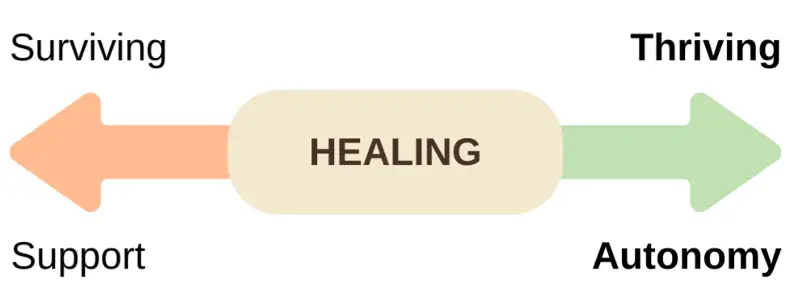
It is impossible to achieve goals without aiming for specific outcomes. Sometimes the challenges we face as survivors make it hard to believe that it is possible to move from surviving, to thriving.
As a community, we identified six key outcomes that we believe are important in rebuilding our lives.
Meet core needs
| Housing | Affordable, long-term. |
| Safety | Safety means different things to different people. It can be physical, emotional/psychological, or social safety. |
| Stability | Shifting circumstances undermine the stability needed to heal and work toward long term goals. |
| Connection | Isolation and loneliness increase risk of revictimisation. |
| Sustainability | Pathways to education, training, income or employment. |
| Purpose | Purpose fosters resilience, provides motivation and strength to fight for healing. |
Provide hope
| Learn from others | Believing that healing and thriving is possible because of shared journeys of recovery. |
| Centre a can-do attitude | Systemic barriers decimate hope. Peer support acknowledges the barriers, while finding ways forward with what 'can be done'. |
Promote recovery
| 'Recovery' means different things to different people | Identifying goals and actively supporting someone to work towards them. |
| Solving root causes of harm is the focus | 'Temporary' or short-term solutions lead to instability and limit recovery. Long-term solutions rather than 'band-aid' solutions are actively identified and pursued (for example, housing, income) to help people reclaim functional autonomy. |
Facilitate relational healing
| Discover identity and authenticity | As opposed to referencing the demands of others. |
| Practise new communication skills | Learning to express needs and boundaries. |
| Identify safe interactions | Learning to identify interactions that allow trust to grow, and are reliable, transparent, kind, responsive and respectful of needs. |
| Learn to navigate conflict | Learning to express needs, set boundaries, and regulate emotions. Learning that disagreement can be navigated in respectful ways. |
Affirm dignity
| Acknowledge | Acknowledging individual lived experience but seeing the person beyond the trauma. |
| Deconstruct shame | Deconstructing shame among peers can help support people in recognising that what happened to them doesn't define them. It can foster self-compassion and understanding that trauma does not make them unworthy or unlovable. |
| Create opportunities | Creating a range of opportunities for peers to realise goals and dreams that are important to them. |
| Provide feedback and validation | This is critical to someone who's sense of worth has been systematically decimated. |
Develop functional autonomy
| Empower choice | Supporting someone to consider all options available to them. |
| Identify priorities | Supporting someone to identify priorities when complex needs become overwhelming. |
| Create a safe space to practice making own decisions | Celebrate a 'no' and boundary setting, foster a culture of learning, even from mistakes. |